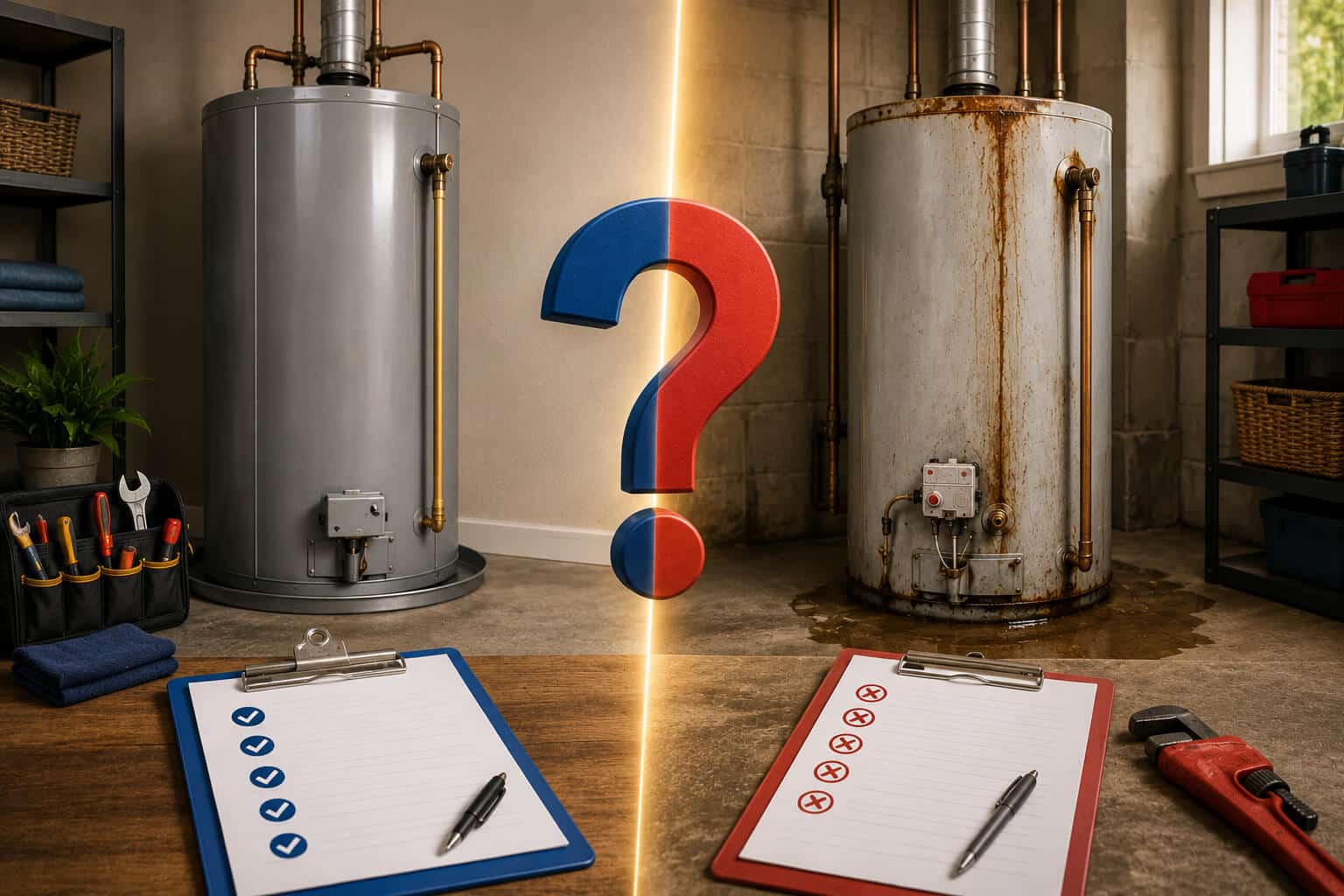
A water heater warranty is worth checking when the unit starts having trouble, but warranty status answers only one part of the problem.
It can tell you whether manufacturer coverage may still apply. It cannot tell you why the water heater is leaking, losing hot water, showing an error, or operating differently than it used to.
The manufacturer confirms the warranty. Gold Star Plumbing diagnoses the water heater.
If you are calling about a water-heater problem, having the model and serial number ready can make the first conversation more useful. It also gives you a head start on determining whether manufacturer coverage may become relevant after the problem is identified.
Find the Model and Serial Number First
Start with the rating plate on the water heater.
On a traditional storage heater, the label is typically attached to the exterior of the tank. Tankless units also carry identifying information on the equipment cabinet.
Take a clear photo rather than trying to copy a long string of letters and numbers by hand. Make sure both the model number and serial number are readable.
The model number identifies the product and equipment configuration. The serial number identifies the individual unit and is commonly used by manufacturers to retrieve production and warranty information.
Manufacturers use different serial-number formats, so there is no single decoding method that applies to every water heater. Rheem, for example, publishes its own serial-number format and uses the serial number in its warranty verification system.
If the label is difficult to reach or unreadable, leave it for the service visit rather than removing covers or moving equipment simply to get a better look.
Check the Manufacturer’s Warranty Record
Once you have the serial number, use the manufacturer’s official warranty or product-support system.
The manufacturer controls the warranty record and the terms attached to the individual product. Third-party age or warranty calculators may be useful for general reference, but they do not replace the manufacturer’s own record when actual coverage matters.
Rheem
Rheem provides an official Verify Your Warranty system. The product serial number is required to check warranty terms and coverage.
Rheem also uses the serial number throughout its water-heating support resources to retrieve product age, documentation, warranty information, and parts.
A. O. Smith
A. O. Smith provides an official Warranty Verification tool that accepts a serial number or reference number.
The company also makes an important distinction: a warranty lookup result does not automatically guarantee reimbursement. Previous replacement, improper installation, and other warranty conditions can affect the final determination.
Bradford White
Bradford White’s official Warranty Center allows owners to enter the water heater serial number and retrieve information including warranty length, expiration date, and manufacture date.
Bradford White uses its own serial-number date system, which illustrates why the manufacturer’s own lookup method matters. A code that works for one brand should not be applied to another.
If You Have Another Brand
Start with that manufacturer’s official warranty or product-support page.
The exact process may differ, but the principle stays the same: identify the unit accurately and use the manufacturer that issued the warranty to determine its status.
What the Warranty Result Actually Changes
An active warranty can matter financially, but it does not identify the failed part.
A water heater can be within its warranty period and still need professional diagnosis before anyone knows whether the problem involves a covered component or condition.
The reverse also matters. An expired warranty does not automatically mean the water heater should be replaced. A unit outside manufacturer coverage can still have a repairable problem.
For an operating problem, Gold Star evaluates the heater itself: what the unit is doing, the condition of the equipment, and where the failure is coming from.
Once that is known, the warranty result becomes useful context.
If the heater needs service, the warranty is only the starting information. Diagnosis comes next. If replacement is eventually recommended, that is when questions about the next system become relevant.
For traditional water-heater diagnosis, repair, and replacement, continue to our Water Heater Services page.
Keep Installation Records With the Warranty Information
If you still have the original installation invoice, purchase paperwork, registration information, or manufacturer documents, keep them with the serial-number information.
The manufacture date and installation date are not necessarily the same, and warranty terms vary by manufacturer and product.
A serial-number lookup should therefore be read together with the manufacturer’s actual warranty terms rather than reduced to “the heater is this old, so it must be covered.”
What to Have Ready When You Call
Three pieces of information can make the first conversation more productive.
First, take a clear photo of the rating plate so the model and serial number can be read.
Second, have any warranty or installation paperwork available, including the manufacturer’s warranty result if you have already checked it.
Third, describe what the water heater is actually doing. Be specific about the problem you are seeing, such as unreliable hot water, visible water around the unit, an error code, or another change in operation.
That gives us two useful starting points: which heater is installed and what problem it is having.
If the unit is tankless and the issue involves error codes, ignition, performance, or scale, our Tankless Water Heater Repair page covers that service specifically.
What If the Manufacturer Requires a Service Professional?
Follow the procedure specified by that manufacturer, because warranty processes differ across brands. Bradford White, for example, states that warranty claims are submitted through the service professional repairing or replacing the heater and coordinated through that contractor’s distributor. A. O. Smith directs owners seeking warranty repair service toward service providers as well.
Those are brand-specific examples. Gold Star diagnoses and services water heaters. Any manufacturer warranty procedure has to follow that manufacturer’s requirements and the circumstances of the specific unit.
If diagnosis eventually leads to replacement and you are deciding whether to install another storage heater or change system types, our Tankless vs. Traditional Water Heater guide covers that separate decision.
Have a Water Heater Problem?
If your water heater is leaking, failing to produce reliable hot water, or otherwise needs professional diagnosis, call Gold Star Plumbing at (615) 290-9860.
We serve La Vergne, Nashville, and communities across Middle Tennessee.
Have the model number, serial number, and any warranty information available when possible. They give us useful equipment context while we focus on the question that requires a plumber: what is actually wrong with the water heater?