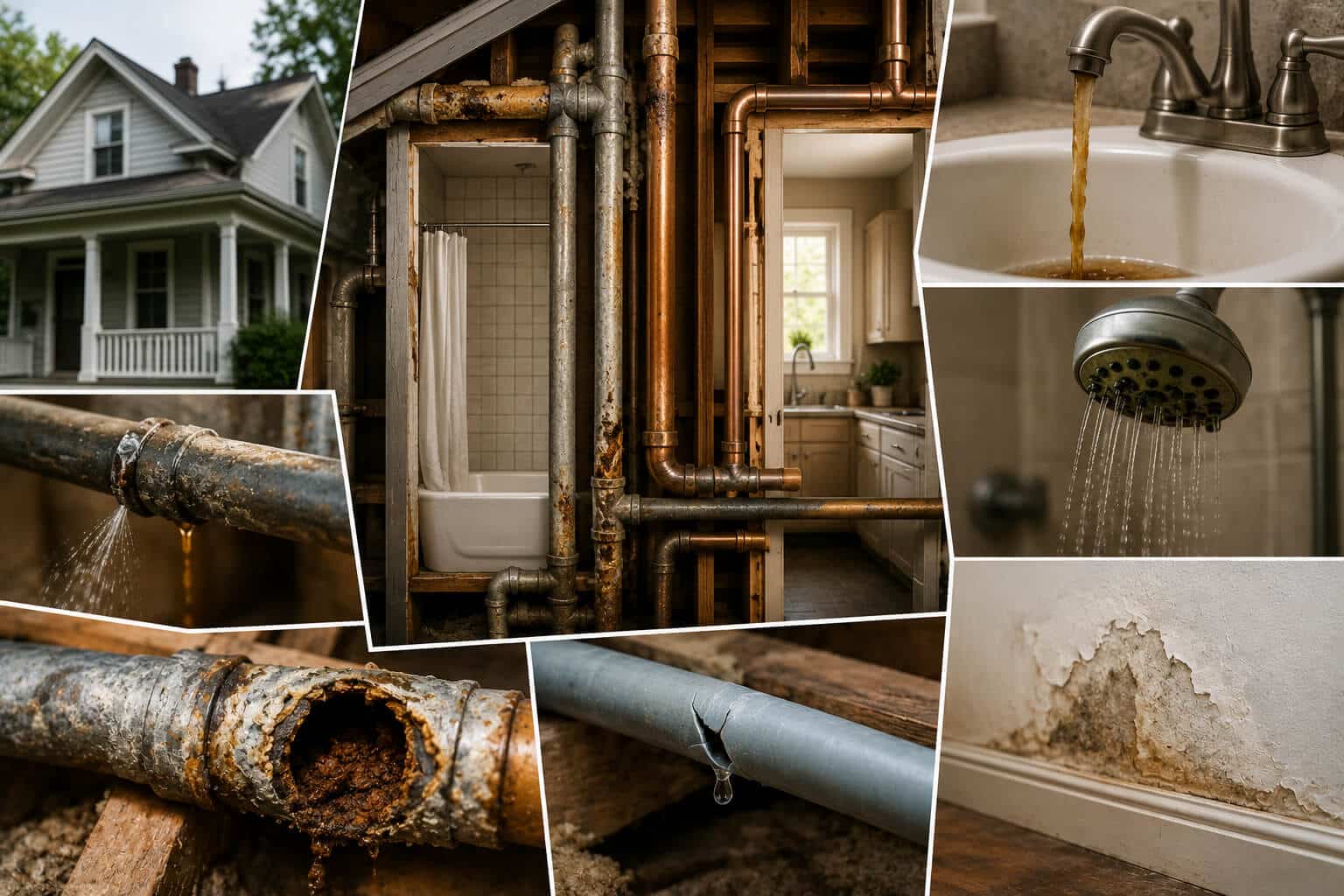
Open the cabinet under one sink and you see copper. Look near the water heater and there is PEX. In the crawlspace, an older gray metal pipe continues toward another part of the house.
That does not automatically mean the plumbing was installed incorrectly.
It may mean the house has been updated in stages.
A remodeled bathroom, a repaired leak, a kitchen renovation, and a larger repiping project can all leave newer water-supply pipe behind. In an older home, several generations of plumbing can end up connected to the same system.
For a buyer or homeowner trying to understand what was actually replaced, a more useful question is:
How much of the water-supply system appears to have been replaced?
Gold Star treats those as separate questions. First figure out how much was changed. Then, if there is a current plumbing problem, assess the condition of what remains.
First, Make Sure You Are Looking at Water-Supply Piping
An older home can contain several pipe materials without having undergone a partial repipe because different plumbing systems do different jobs. The smaller pressurized lines carrying hot and cold water to faucets, showers, toilets, and appliances are supply piping. Larger pipes carry wastewater through the drain and sewer system, while the underground service line bringing water toward the house is another separate part of the plumbing.
So copper supply piping beside PVC drainage tells you very little about whether the home’s water-supply system was repiped. For this question, compare supply piping with supply piping. Accessible areas such as under sinks, around the water heater, in unfinished basements, utility spaces, or crawlspaces may show enough of those lines to begin placing previous work into context.
Place What You See on a Five-Level Scale
“The plumbing was updated” can describe anything from one replaced connection to a whole-house repipe. Those are very different scopes, so for this article we use a simple five-level scale to place the visible work.
| Level | What you may find | What that tells you |
|---|---|---|
| 1. Fixture-level update | New shutoff, connector, or short section at one fixture | Work was performed at that fixture |
| 2. Room-level update | New supply piping concentrated around one remodeled kitchen or bathroom | That room or fixture group was updated |
| 3. Branch-level replacement | A newer run serves one area before tying into older supply piping | A larger section was replaced, but older distribution piping remains |
| 4. Partial repipe | Newer piping extends through several parts of the house while identifiable older supply piping remains elsewhere | A meaningful portion of the supply system was replaced, but not all of it |
| 5. Whole-home repipe | Newer supply piping appears consistently throughout the accessible distribution system and project records describe whole-home replacement | The evidence supports that most or all of the interior supply system was replaced |
This scale is more useful than treating every piece of PEX or copper as proof that “the house was repiped.”
New PEX under a renovated bathroom sink, for example, belongs near the first or second level until there is evidence that the newer piping continues farther through the house. PEX visible in several rooms may move the picture higher. But if those runs still connect to older galvanized, copper, polybutylene, or another previous material elsewhere, you are looking at a mixed system rather than one uniformly replaced network.
What matters here is how much of the system changed, beyond the fact that some of it looks new.
Use Transitions and Paperwork to Refine the Picture
Material transitions are especially useful because they show where one generation of plumbing meets another. Suppose newer PEX serves a bathroom but ties into an older metal supply line in the crawlspace. That connection tells a clearer story than the PEX alone: the work may have reached the bathroom branch without continuing through the older upstream piping.
Then compare that physical evidence with any records that came with the house.
An invoice saying “replace bathroom supply lines” supports a room-level or branch-level project, while paperwork describing a whole-home repipe supports a much broader scope. A seller disclosure or inspection report saying only that “plumbing was updated” is less useful because the word updated leaves the scope unclear.
For a home buyer, that distinction matters before treating a renovation claim as evidence that the supply system was completely replaced.
For someone who already owns the house, it matters when an older section develops a problem. A prior update in one part of the house can still leave older sections from an earlier system elsewhere.
You do not need an exact installation year for every visible pipe to make the distinction. You need to know whether the evidence points to one fixture, one room, one branch, several sections, or the whole supply network.
If you are buying the home and the evidence appears to fall around Level 3 or Level 4, or you cannot tell where newer piping ends and older piping begins, that is the point to ask for clearer documentation or an independent plumbing evaluation before relying on “updated plumbing” as a whole-home description.
Where the Scope Question Ends
There is a limit to what visible plumbing can establish. A wall can hide the transition between old and new pipe, a finished ceiling can conceal a branch that was never replaced, and documentation may describe work that is no longer visible. That uncertainty does not erase what you have learned.
If newer piping is confined to one room, you should not treat the house as fully repiped. If new and old supply materials are visible in several areas, you know the system is mixed. If newer piping appears throughout the accessible system and the project records describe whole-home replacement, you have much stronger evidence of a complete repipe.
What the visible evidence cannot determine by itself is the condition of every concealed section or whether any remaining older piping now needs replacement.
That is where the question changes.
If the next concern is whether the remaining interior supply piping warrants targeted work or broader replacement, continue to Gold Star’s Re-piping Services.
What About the Main Water Line?
Keep the underground water service separate from that conclusion.
A house can have newer interior supply piping and an older water line between the house and public supply, or the reverse.
If the concern involves the underground line serving the house, Gold Star handles that separately through Water Line Repair & Replacement.
That service addresses whether the underground line needs a localized repair or full service-line replacement.
Here, the question remains how much of the interior water-supply system appears to have been updated already.
Buying or Living in an Older Home With Mixed Plumbing?
If someone tells you the plumbing was updated, ask one more question:
What was actually replaced?
Use the visible material transitions and any available project records to place the work on the scale above.
If you are buying the property and the evidence is incomplete, clarify the scope before treating a partial update as a whole-home repipe.
If you already own the home and the remaining piping is developing leaks, pressure problems, or other performance concerns, that is where a current condition assessment becomes useful.
To discuss whether mixed piping points to a limited past update or a broader repiping issue, call Gold Star Plumbing at (615) 290-9860.
We serve La Vergne, Nashville, and communities across Middle Tennessee.
The goal is to know how much was changed before deciding what, if anything, needs to happen next.