A Rutherford County address does not automatically tell you how wastewater leaves the property.
One home may connect to a public sewer. Another may use a private septic system. A third may be served by a STEP system through Consolidated Utility District of Rutherford County.
Those systems can begin at the same sinks, toilets, and showers inside the house while placing records, equipment, and service responsibility in different hands.
Before deciding who should handle a wastewater question, identify the system serving the property.
Rutherford County Has More Than One Wastewater Path
Rutherford County’s own permitting materials make the distinction visible.
For a new single-family dwelling, the county lists a TDEC Septic Permit or a C.U.D. STEP Permit among the possible required documents. Separate residential guidance notes that septic-record requirements do not apply to homes connected to a CUD STEP system or Murfreesboro city sewer. See Rutherford County’s current Residential Building Codes information.
The county’s Planning and Engineering FAQ uses the same distinction in its permitting path, with exceptions for STEP systems and properties on city sewer.
That is enough to rule out a common shortcut: “Rutherford County” does not describe one wastewater system.
The better starting point is the property’s records and utility relationship.
Start With Records and Accounts
The answer may already exist in documents connected to the property.
| What you find | What it may indicate |
|---|---|
| A sewer account with a city or public wastewater provider | The property is likely connected to that public sewer system |
| TDEC septic records or an SSDS permit | The property has documentation for a subsurface sewage disposal system |
| CUD STEP documentation, a STEP account, or STEP equipment at the property | The property may be part of a CUD STEP system |
| Closing documents or permit records naming the wastewater system | A lead that can be verified with the responsible agency or utility |
Tennessee’s Department of Environment and Conservation maintains an SSDS record search and septic-system permitting program.
Consolidated Utility District publishes separate STEP system guidance for properties it serves.
Use those records to identify the system before assigning a service problem to the wrong organization.
A CUD STEP Property Follows Its Own Service Path
A STEP system follows a different service path from an ordinary private septic system.
CUD says the STEP system on the property, including the STEP risers and pipes, is owned by the utility. Its homeowner guidance tells customers to call CUD first when the STEP alarm sounds or the STEP system itself needs service. CUD also gives homeowners a practical distinction: when a wastewater problem occurs and the STEP alarm does not sound, the problem is more likely to be on the household plumbing side. See CUD’s STEP Systems: Your Guide.
If the STEP alarm sounds or the STEP system itself needs service, start with CUD.
If CUD rules the STEP system out, the remaining question may belong to the home’s plumbing.
If Records Point to Septic, Separate the Septic System From the Household Plumbing
For the septic system itself, use Tennessee’s TDEC septic permitting and records process.
Tennessee’s Division of Water Resources oversees Subsurface Sewage Disposal Systems, including permits, record searches, and information for permitted septic installers and pumpers.
If the records point to septic equipment, the tank, pumping, drain field, or septic permitting belongs on the septic-professional and TDEC side of the line.
Do not assume that makes every sink, toilet, drain, or supply-pipe problem a septic problem. A problem in the home’s fixtures or pipes can still be separate from the septic tank or drain field.
Public Sewer Changes the Responsibility Question
A confirmed public-sewer connection opens a different question: where does private responsibility end and the public system begin?
That boundary depends on the local provider. The guide to sewer responsibility in Nashville and La Vergne explains the published boundaries without treating the two cities as interchangeable. If a Rutherford County property is served by another provider, confirm that provider’s current responsibility rule before deciding who handles the line.
If the remaining issue is the physical condition of a private sewer line, move to Gold Star’s sewer camera inspection service to evaluate what is physically happening inside the line.
Frequently Asked Questions
What does STEP equipment actually look like on the property?
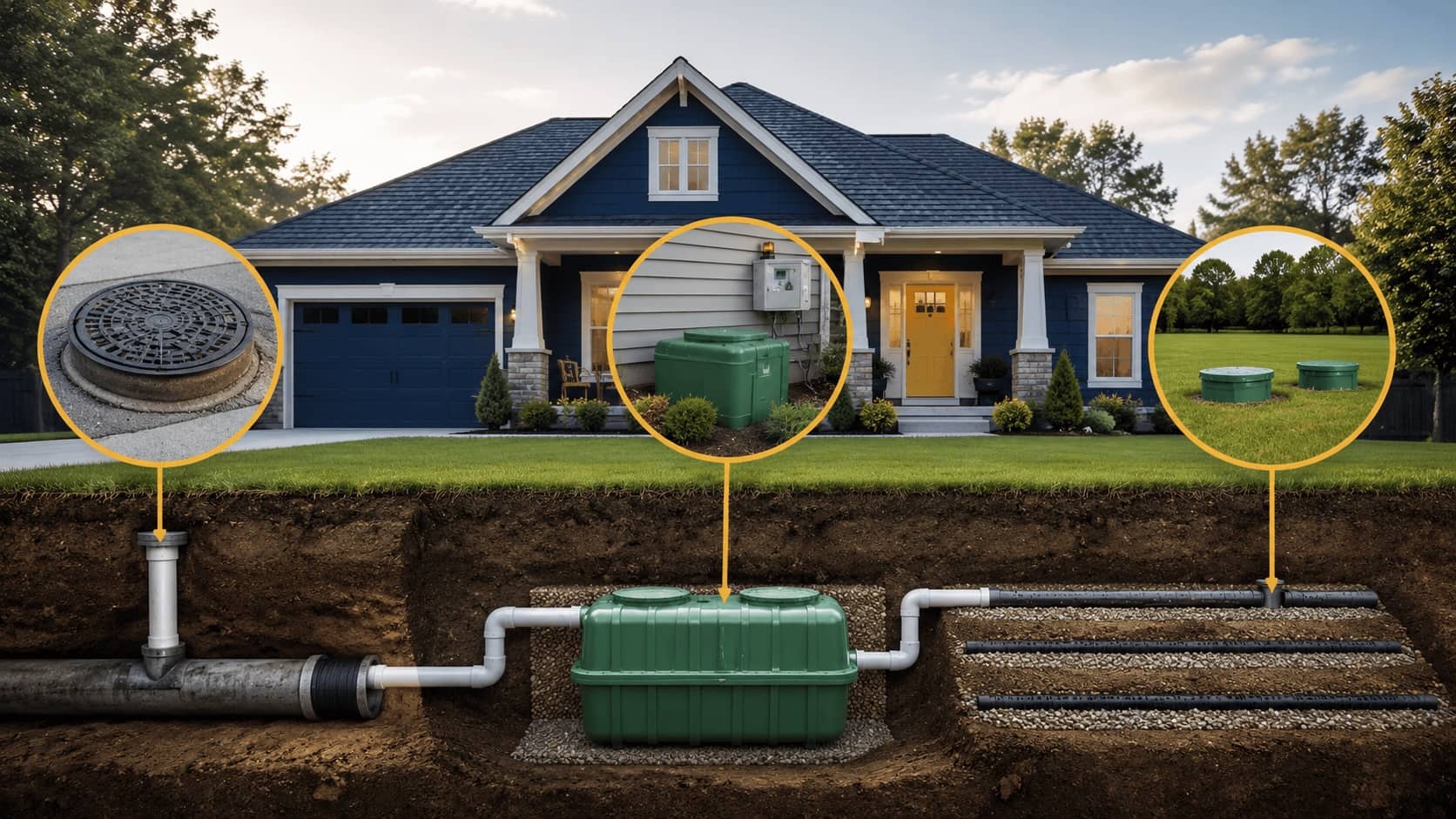
CUD says a STEP-served home will typically have an exterior control box with an alarm. It also describes the STEP risers as green-topped manhole-style covers in the yard. Those are useful clues, but records and the utility account are still the better way to confirm that the property is actually on a CUD STEP system.
What happens to a CUD STEP system during a power outage?
CUD says a power outage by itself does not require an immediate service call. The system is designed to resume normal operation when power returns, and the tank has capacity for about 24 hours of limited household use during an outage. If the electric utility cannot restore power within 24 hours, CUD tells customers to contact the district and to limit water use while the outage continues.
If the property is on septic, can a plumber still work on the household plumbing?
Yes, a septic-served home still has household plumbing before wastewater reaches the septic system. The Residential Plumbing Services page covers plumbing repairs and installations inside the home. Work on the septic tank, pumping, drain field, or septic permitting remains on the septic-professional and TDEC side of the line.
Rutherford County, TDEC, and CUD information checked: August 18, 2026. Recheck before publication.
Gold Star Plumbing serves La Vergne, Nashville, and Rutherford County communities. If system identification points back to household plumbing, or a confirmed public-sewer property needs its private sewer line evaluated, call us at (615) 290-9860.
Sewer, septic, and STEP may begin at the same household drains.
Identifying which system serves the property tells you who should answer the next question.